

 인스티즈앱
인스티즈앱 
이런 보도가 있어서 한동안 매스컴이나 인터넷에 노력 무용론글이 많이 올라왔죠.
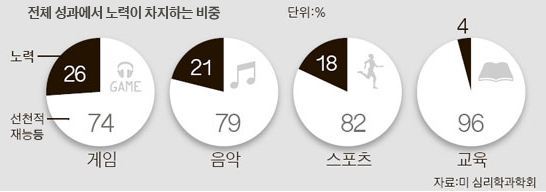
이렇게 해석하고 있습니다.
우리나라 보도에서
노력,재능을 양분해서 표현했는데요
노력 이외의 %를 재능이라고 포괄해서 표현한 것이 잘못되었습니다.
노력 4% 이외의 96%라는 범위 내에는 이런 요인들도 있습니다.
-몇살때부터 시작했는가? (<----이게 과연 선천적재능의 카테고리에 묶일 변수인가요? 재능이 아니라 선택요소 아닌가요?)
-인내심 (<-공부라는 특정 분야의 재능이라기 보다는 그냥 성격이나 멘탈쪽 카테고리로 따로 봐야 하지 않을까요?
물론 인내심을 재능이라고 볼 수도 있지만, 힘든 과정을 묵묵히 견디고 지속하는 노력의 개념도 포함된 요소 아닐까요?)
-동기 (<-이것은 정말 후천적인,환경적인 요인 아닐까요?)
-영감 (<-이 도표를 보고 우리가 생각한 재능이라는 단어의 늬앙스하고 다소 동떨어지지 않나요?)
www.princeton.edu/main/news/archive/S40/43/14C80/
그리고..., 원문을 보면
4%인 이유로 들고 있는게 앞서 배워 이미 알고 있던 지식을 습득하기 위해 했던 노력을 평가하기가 힘들어서라고 하네요.
노력의 영향력이 미미하다는것보다는 노력을 평가하기 힘들어서 나온 수치라고 보는게 맞죠
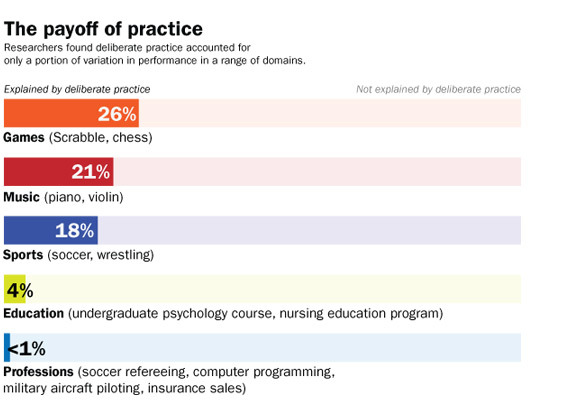
노력vs재능이 아니라
노력vs노력 이외의 모든 변수입니다.
이 논문의 주요쟁점은
모든건 선천적으로 정해져있으니 노력하지 말라는게 아니라
노력으로는 성과의 일부분만 설명가능해서 다른 요소들을 연구해야 한다는 내용입니다.
어떠한 곳에서도 선천적재능이 96%니깐 노력 무용론을 주장하는 부분이 없습니다.
노력 이외의 모든 변수를 선천적재능이라고 말하는 부분도 없습니다.
원문 내용 속엔에는 노력 이외의 성과를 설명 할 수 있는 요소를 찾기 위해
시작연령,지성,성격을 연구할 필요가 있다고 말하는 부분이 있습니다.
우리나라 보도에서 "재능"이라고 말한 것은 원문에선 노력 이외의 모든 것을 말합니다.
노력의 여집합이 재능은 아니지 않습니까?
“We found that, yes, practice is important, and of course it’s absolutely necessary to achieve expertise,” said Zach Hambrick, a psychologist at Michigan State University and a co-author of the paper, with Brooke Macnamara, now at Case Western Reserve University, and Frederick Oswald of Rice University. “But it’s not as important as many people have been saying” compared to inborn gifts.
원문의 글은 노력의 무용론이 아니라 노력 이외의 다른 수많은 요소들에 대해서도 생각해보자는 취지의 글이었는데
우리나라에선 왜 노력 무용론을 주장하는 글로 탈바꿈 한 걸까요?
노력이 의미가 없다면
교육은 왜 있고? 각 분야별 전문 트레이닝은 왜 있을까요?
그냥 날때부터 정해진건데?
왜 원문의 내용과 의도를 편집해서 자신들의 기호에 맞게 보도할까요?
원문의 쟁점은 [노력 이외에도 성과를 결정 짓는 요소는 많다. 노력 이외의 요소에 대해서도 연구가 필요하다] 입니다
논문의 취지로 볼 때 "선천적 재능이나 노력 둘 다 중요하지 않을 수 있다"로 볼 수도 있습니다.
아래는 원문과 이 보도의 오역을 발견하신분의 블로그 주소입니다. 참고하시길
<영문 기사 전문>
How Do You Get to Carnegie Hall? Talent
By BENEDICT CAREY JULY 14, 2014
The 8-year-old juggling a soccer ball and the 48-year-old jogging by, with Japanese lessons ringing from her earbuds, have something fundamental in common: At some level, both are wondering whether their investment of time and effort is worth it.
How good can I get? How much time will it take? Is it possible I’m a natural at this (for once)? What’s the percentage in this, exactly?
Scientists have long argued over the relative contributions of practice and native talent to the development of elite performance. This debate swings back and forth every century, it seems, but a paper in the current issue of the journal Psychological Science illustrates where the discussion now stands and hints — more tantalizingly, for people who just want to do their best — at where the research will go next.
The value-of-practice debate has reached a stalemate. In a landmark 1993 study of musicians, a research team led by K. Anders Ericsson, a psychologist now at Florida State University, found that practice time explained almost all the difference (about 80 percent) between elite performers and committed amateurs. The finding rippled quickly through the popular culture, perhaps most visibly as the apparent inspiration for the “10,000-hour rule” in Malcolm Gladwell’s best-selling “Outliers” — a rough average of the amount of practice time required for expert performance.
The new paper, the most comprehensive review of relevant research to date, comes to a different conclusion. Compiling results from 88 studies across a wide range of skills, it estimates that practice time explains about 20 percent to 25 percent of the difference in performance in music, sports and games like chess. In academics, the number is much lower — 4 percent — in part because it’s hard to assess the effect of previous knowledge, the authors wrote.
“We found that, yes, practice is important, and of course it’s absolutely necessary to achieve expertise,” said Zach Hambrick, a psychologist at Michigan State University and a co-author of the paper, with Brooke Macnamara, now at Case Western Reserve University, and Frederick Oswald of Rice University. “But it’s not as important as many people have been saying” compared to inborn gifts.
One of those people, Dr. Ericsson, had by last week already written his critique of the new review. He points out that the paper uses a definition of practice that includes a variety of related activities, including playing music or sports for fun or playing in a group.
But his own studies focused on what he calls deliberate practice: one-on-one lessons in which an instructor pushes a student continually, gives immediate feedback and focuses on weak spots.
“If you throw all these kinds of practice into one big soup, of course you are going to reduce the effect of deliberate practice,” he said in a telephone interview.
Dr. Hambrick said that using Dr. Ericsson’s definition of practice would not change the results much, if at all, and partisans on both sides have staked out positions. Like most branches of the nature-nurture debate, this one has produced multiple camps, whose estimates of the effects of practice vary by as much as 50 percentage points.
“This is where we are, with people essentially talking past one another,” said Scott Barry Kaufman, a psychologist at the University of Pennsylvania and scientific director of the Imagination Institute, which funds research into creativity. And because truly elite performance takes many years to achieve, he said, the exact contribution of practice may never be known precisely.
Yet the range of findings and level of disagreement are themselves hints that there are likely to be factors involved in building expertise that are neither genetic nor related to the amount of practice time.
One is the age at which a person picks up a violin, or a basketball, or a language. People who grow up in bilingual households fully integrate both languages at the same time that language-specialized areas in their brains are developing. The same may be true of many other skills — there may exist a critical window of learning in childhood that primes the brain to pick up skills quickly later on.
Other factors are much easier to control. For instance, scientists have shown that performance itself — that is, testing oneself, from memory — is a particularly strong form of practice. one of the studies that the new review paper includes found that chess masters with similar abilities varied widely in the amount of hours they reported practicing, from 3,000 to more than 25,000.
“We may find when looking more closely that playing in tournaments, under pressure, is an important factor,” Dr. Hambrick said.
The content of isolated practice is another. In dozens of experiments, scientists have shown that mixing related skills in a single practice session — new material and old, scales and improvisation, crawl and backstroke — seems to sharpen each skill more quickly than if practiced repeatedly on its own. Varying the place and timing of practice can help as well, for certain skills, studies suggest.
“The question is: What is the optimal kind of practice in the area you wish to achieve expertise?” Dr. Ericsson said. “These are things we are now beginning to study, in areas like medical training.”
Practice time is critical indeed, and its contribution to accumulated expertise is likely to vary from one field to the next as the new paper found, experts said. Personality is an enormous variable, too, (although partly genetic). “Things like grit, motivation, and inspiration — that ability to imagine achieving this high level, to fantasize about it,” Dr. Kaufman said. “These are things we don’t know much about yet, and need to study more directly.”
But in the end, the most important factor over which people have control — whether juggling, jogging or memorizing a script — may be not how much they practice, but how effectively they use that time.
A version of this article appears in print on July 15, 2014, on page D1 of the New York edition with the headline: How Do You Get to Carnegie Hall? Talent.
<프린스턴 대학교 뉴스 전문>
Becoming an expert takes more than practice
Posted July 3, 2014; 12:00 p.m.
by Office of Communications
Practice doesn't make it perfect.
Deliberate practice may have less influence in building expertise than previously thought, according to an analysis by researchers at Princeton University, Michigan State University and Rice University.
Scientists have been studying and debating whether experts are "born" or "made" since the mid-1800s. In recent years, deliberate practice has received considerable attention in these debates, while innate ability has been pushed to the side.
The recent focus on deliberate practice is due in part to the "10,000-hour rule" coined in Malcolm Gladwell's 2008 book "Outliers," which says that amount of practice is the key to success in any field.
The new research, from psychological scientist Brooke Macnamara of Princeton and colleagues, offers a counterpoint to this recent trend, suggesting that the amount of practice accumulated over time does not seem to play a huge role in accounting for individual differences in skill or performance in domains including music, games, sports, professions and education.
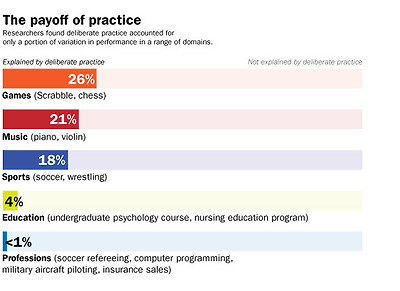
Overall, deliberate practice — activities designed with the goal of improving performance — accounted for only about 12 percent of individual differences observed in performance.
"Deliberate practice is unquestionably important, but not nearly as important as proponents of the view have claimed," said Macnamara, who received her Ph.D. from Princeton in June. As of July 1, she is an assistant professor in the Department of Psychology at Case Western Reserve University.
The new analysis by Macnamara, David Z. Hambrick of Michigan State and Frederick Oswald of Rice is the subject of their paper, "Deliberate Practice and Performance in Music, Games, Sports, Education and Professions: A Meta-Analysis," published online Monday, July 1, by the journal Psychological Science.
The researchers scoured the scientific literature for studies examining practice and performance in the different domains.
Of the many studies they found, 88 met specific criteria, including a measure of accumulated practice and a measure of performance, and an estimate of the magnitude of the observed effect. The selected studies had a total sample size of 11,135 participants. The researchers took those studies and performed a "meta-analysis," pooling all of the data from the studies to examine whether specific patterns emerged.
Nearly all of the studies showed a positive relationship between practice and performance: the more people reported having practice, the higher their level of performance in their specific domain.
The domain itself seemed to make a difference. Practice accounted for about 26 percent of individual differences in performance for games, such as chess and Scrabble; about 21 percent of individual differences in music, such the piano and violin; and about 18 percent of individual differences in sports, such as soccer and wrestling.
But it only accounted for about 4 percent of individual differences in education, such as an undergraduate psychology class, and less than 1 percent of individual differences in performance in professions, such as soccer refereeing and computer programming.
Furthermore, the findings showed that the effect of practice on performance was weaker when practice and performance were measured in more precise ways, such as using practice time logs and standardized measures of performance.
"There is no doubt that deliberate practice is important, from both a statistical and a theoretical perspective. It is just less important than has been argued," Macnamara said. "For scientists, the important question now, is what else matters?"
Macnamara and colleagues speculate that the age at which a person becomes involved in an activity may matter, and that certain cognitive abilities (such as working memory) may also play an influential role. The researchers are planning another meta-analysis focused specifically on practice and sports to better understand the role of these and other factors.
David Lubinski, a professor of psychology at Vanderbilt University who has studied talent identification and development, said the researchers' work highlights the importance of accounting for ability, commitment and opportunity to explain individual differences in human performance.
"Although overly stressing one of these critical components may attract attention, the authors show why all three are required for a comprehensive understanding of human performance," he said. "The view that essentially anyone can do essentially anything is not scientifically defensible."
http://m.blog.daum.net/_blog/_m/articleView.do?blogid=0fqji&articleno=683
 한국에서 네스퀵보다 제티였던 이유